The right anti-reflux operation for you — and why it lasts
If you're weighing surgery for reflux, you've probably reached the point where medication isn't enough and you want this behind you for good. The worry underneath that is usually twofold: will an operation actually hold, and will it trade heartburn for a new set of problems you end up living with instead. Both are the right questions to ask. And the answer to both is the same. It depends far less on having surgery than on having the right operation, done well, on fixing what's actually driving the reflux rather than just quieting it.
That's where anti-reflux surgery at SCMSC begins. Not with a single default procedure, but with the question most of the decision turns on: which operation does your reflux, and your anatomy, actually call for?

What anti-reflux surgery involves — and how it's matched to you
For most people, reflux surgery means a fundoplication: the top of the stomach is wrapped around the lower esophagus to rebuild the valve that's meant to keep acid down. But in a great many patients, the reflux is being driven by a hiatal hernia, where part of the stomach has pushed up through the diaphragm and weakened that barrier. When that's the case, repairing the hernia isn't a separate operation off to the side. It's the part that makes the reflux fix last. So at SCMSC the fundoplication and the hiatal (or larger paraesophageal) hernia repair are usually planned and done together, as one operation, minimally invasively or robotically.
The wrap: a full or a partial one
Even the wrap itself isn't one-size-fits-all. It can be a full 360-degree wrap (a "Nissen") or a partial 180-degree wrap (a "Toupet"), and the difference matters more than it sounds. For the right patient, a partial wrap can ease the bloating and difficulty swallowing that people worry about most, while still controlling the reflux. Which one fits you depends on how your esophagus actually moves, which is why that decision comes after testing, not before it.
How the right operation gets chosen
Before recommending an operation, SCMSC works the reflux up properly. That can include an upper endoscopy, pH and impedance testing to measure the reflux itself, and high-resolution manometry to see how your esophagus functions. That information is what turns "you need surgery" into "you need this operation," the one matched to your anatomy, your reflux, and what matters to you about recovery and side effects.
Which anti-reflux surgery is best?
There's no single best anti-reflux operation. The right one depends on what's driving your reflux and how your esophagus moves. A full 360-degree wrap (Nissen), a partial 180-degree wrap (Toupet), and repair of any hiatal hernia are matched to your case after testing, rather than applied by default.
Will it last — and will it give me new problems?
This is the real question underneath "is surgery worth it," and it deserves a straight answer rather than a promise.
On lasting. A well-matched anti-reflux operation gives durable relief for most patients, and that durability comes directly from the two things above: choosing the right wrap, and repairing the hernia that's driving the reflux, rather than doing the biggest possible procedure. No honest surgeon will tell you reflux can never return. What SCMSC offers is the workup and the technique that give the repair its best chance of holding.
On new problems. The side effects people fear, bloating, trouble swallowing, not being able to burp, are real, and they depend heavily on which operation is done and how. This is the whole reason matching matters: a partial wrap instead of a full one can reduce those effects for the patients it suits. When they do occur, most ease in the weeks after surgery. You'll hear all of it discussed plainly before any decision is made, what's likely, what's manageable, and how your plan is built to keep it to a minimum.
Patients who come to SCMSC for this surgery tend to describe the same things afterward: a surgeon who laid the options out honestly, took the time the decision deserved, and was still there through recovery.

Robotic precision, and what recovery looks like
Precision matters in an operation this delicate, because it's what protects both the result and the recovery. SCMSC performs anti-reflux surgery, including robotic fundoplication, minimally invasively wherever it's appropriate, which means smaller incisions, less scarring, and a faster return to normal life. The General Surgery department is led by Dr. Babak Eghbalieh, MD, FACS, Director of General and Robotic Surgery, whose more than 3,300 robotic surgeries set the standard the whole team operates to. The number isn't the point. What practiced robotic hands mean for your outcome is.
Because the surgery is done minimally invasively or robotically, most patients go home within a day or two and are back to normal activity within a few weeks, faster than open surgery would allow. For the first stretch you'll follow a graduated diet, liquids and soft foods first, while the repair settles, and some early bloating or swallowing changes are normal and ease over that time. What matters most is that the surgeon who operated on you follows you through it. Recovery is where a good result is protected, not just the operating room.
What is recovery from anti-reflux surgery like?
Because anti-reflux surgery is performed minimally invasively or robotically, most patients go home within a day or two and return to normal activity within a few weeks. A graduated diet of liquids and soft foods is followed while the repair settles. Mild early bloating or swallowing changes are common and usually ease within weeks.
Is anti-reflux surgery safe and worth it?
For the right candidate, modern anti-reflux surgery is a well-established procedure with durable results and a manageable recovery. Whether it's worth it depends on your situation: how well medication is controlling your reflux, what's driving it, and what the right operation can realistically achieve. A consultation determines that before any commitment.
Hiatal and paraesophageal hernia repair
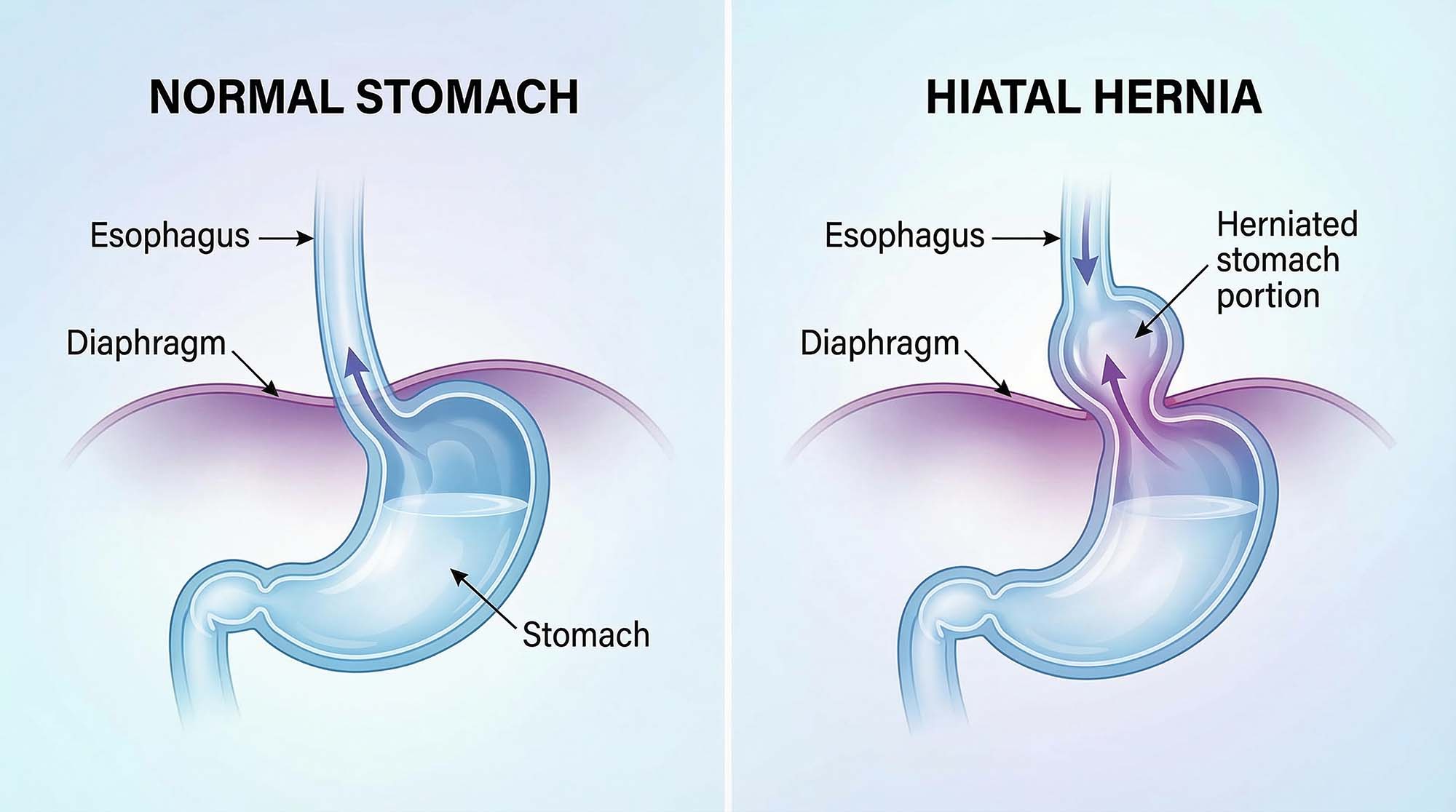
For many people, reflux is being driven by a hiatal hernia — when part of the stomach pushes up through the diaphragm and weakens the barrier against acid. Larger paraesophageal hernias can also cause chest discomfort, trouble swallowing, or a feeling of fullness after eating. Repairing the hernia is often the part of the operation that makes the reflux fix actually last, which is why anti-reflux surgery and hiatal hernia repair are usually one surgical conversation, not two. SCMSC repairs hiatal and paraesophageal hernias — including large and complex ones — minimally invasively and robotically, at the same time as the reflux procedure when that's the right approach.
If a previous reflux operation hasn't held
If you've already had anti-reflux surgery and the reflux has come back, or a wrap has slipped or loosened, you are not out of options — and you don't have to resign yourself to living with it again. Revision (redo) anti-reflux surgery is more complex than a first operation and is not something every practice takes on, but it's exactly the kind of case SCMSC accepts. A failed prior fundoplication deserves an expert second look at what went wrong and what can be rebuilt — including, for a shortened esophagus, specialized techniques to restore a durable repair. Many patients who were told "nothing more can be done" have other paths worth evaluating.
Why patients choose SCMSC for anti-reflux surgery
Reflux surgery is a decision most people make once, so it's worth making with a practice built to handle whatever your case turns out to be.
- Your case isn't too complicated. SCMSC routinely accepts complex and revision cases, including patients whose prior surgery failed, or who were told their situation was too difficult.
- The same surgeon carries you through. With surgery, the months afterward matter as much as the operation. The surgeon who evaluates and operates follows you through recovery, well past the standard post-op visit, which is how problems get caught early and the result holds.
- The depth is there when a case needs more. For complex cases, SCMSC has access to hospital-grade surgical infrastructure at Providence Saint John's in Santa Monica, and in-house [clinical nutrition](/clinical-nutrition/) for the pre- and post-operative support that protects an outcome, especially when weight is part of the reflux picture.
- A second opinion is welcome. SCMSC is regularly chosen as a second or third opinion. If another surgeon has proposed an operation, a consultation here will tell you whether it's the right one, or whether a different one fits you better.
And if you're the one helping a parent or a partner through this, doing the research, sitting in on the decision, you'll be part of the conversation. SCMSC involves the family in surgical planning and keeps you informed, in your language, through the operation and the recovery. You won't be the person left in a waiting room wondering what's happening.
Your consultation — the next step
Your next step is a consultation, not a commitment to surgery. It's where the testing comes together into a clear recommendation: what's driving your reflux, which operation fits your case, what recovery looks like, and what result is realistic. If you're seeking a second opinion, on a surgery you've been offered or on one that didn't hold, that's a straightforward place to begin. Across all five locations in greater Los Angeles, the surgeon who evaluates you is the one who performs your procedure and follows your recovery.
Frequently Asked Questions
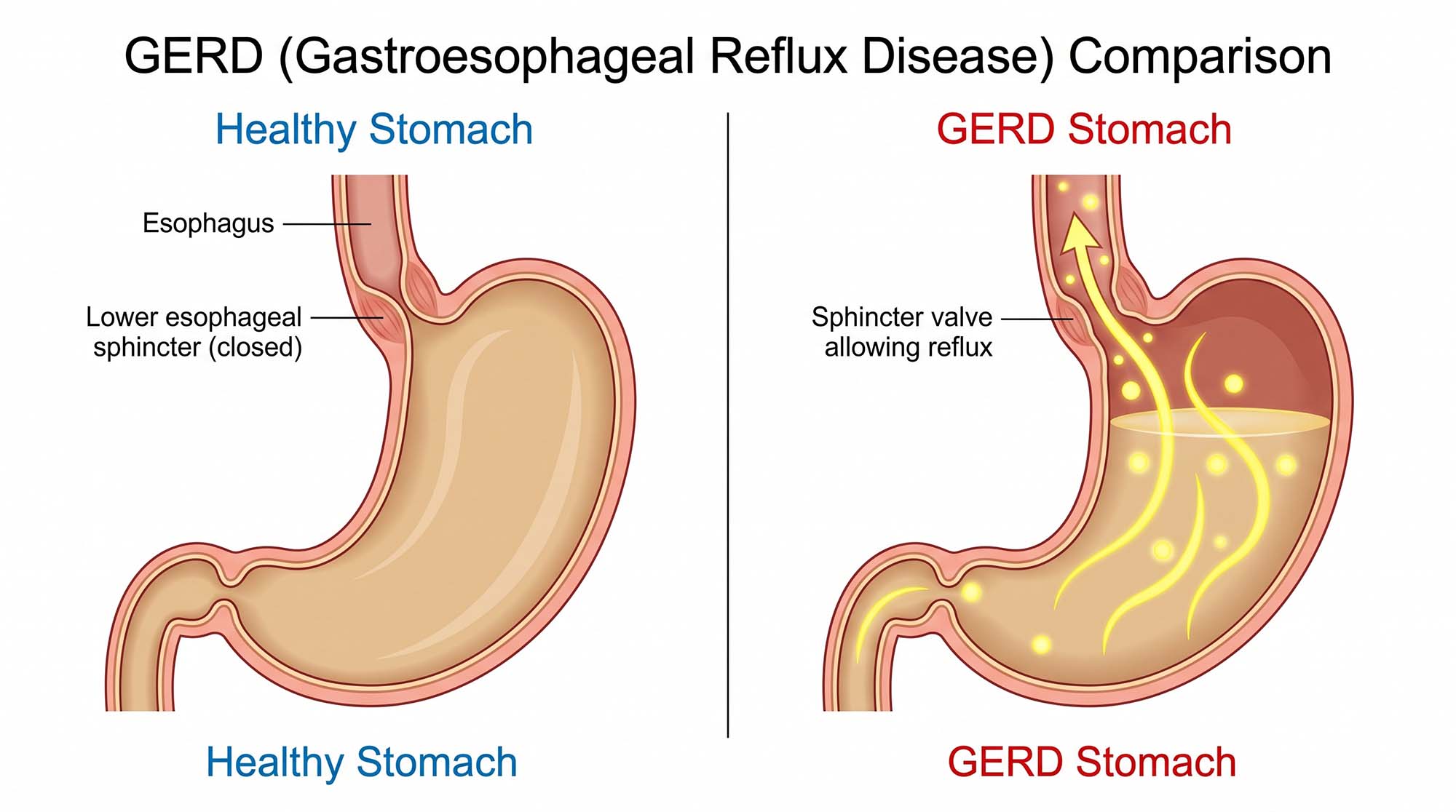
Illustration of a healthy stomach vs one with Gastroesophageal Reflux Disease (GERD).
Which anti-reflux surgery is best?
There's no single best option. A full (Nissen) or partial (Toupet) fundoplication suits different patients depending on anatomy and how the esophagus functions, and any hiatal hernia driving the reflux is usually repaired at the same time. The right choice is made after testing, so the operation fits your case rather than being applied by default.
What's the difference between a Nissen and a Toupet fundoplication?
Nissen is a full 360-degree wrap; a Toupet is a partial 270-degree wrap. Both rebuild the anti-reflux barrier. A partial wrap can reduce bloating and swallowing side effects for the patients it suits, while a full wrap may control reflux more completely for others. Testing of how your esophagus moves determines which is right for you.
How long does anti-reflux surgery last? Is it permanent?
A well-matched anti-reflux operation gives durable relief for most patients, particularly when any hiatal hernia driving the reflux is repaired at the same time. No operation guarantees reflux can never return, but choosing the right procedure and fixing the underlying cause give the result its best chance of lasting.
Is hiatal hernia repair done at the same time as reflux surgery?
Usually, yes. When a hiatal or paraesophageal hernia is driving the reflux, repairing it is often what makes the fix last, so it's typically done together with the fundoplication as one minimally invasive or robotic operation.
What are the side effects of fundoplication?
The most common are temporary bloating, difficulty swallowing, and reduced ability to burp, which usually ease in the weeks after surgery. Their likelihood and degree depend heavily on which operation is performed. A partial (Toupet) wrap can reduce these effects for the patients it suits, which is why matching the operation to the patient matters.
Can a failed or slipped fundoplication be redone?
Yes. Revision (redo) anti-reflux surgery is more complex than a first operation, but a failed or slipped wrap can often be evaluated and rebuilt. SCMSC accepts revision cases, including patients told elsewhere that nothing more could be done.
Is anti-reflux surgery done robotically?
Yes. SCMSC performs anti-reflux surgery robotically and minimally invasively wherever appropriate, which means smaller incisions, less scarring, and a faster recovery than open surgery.